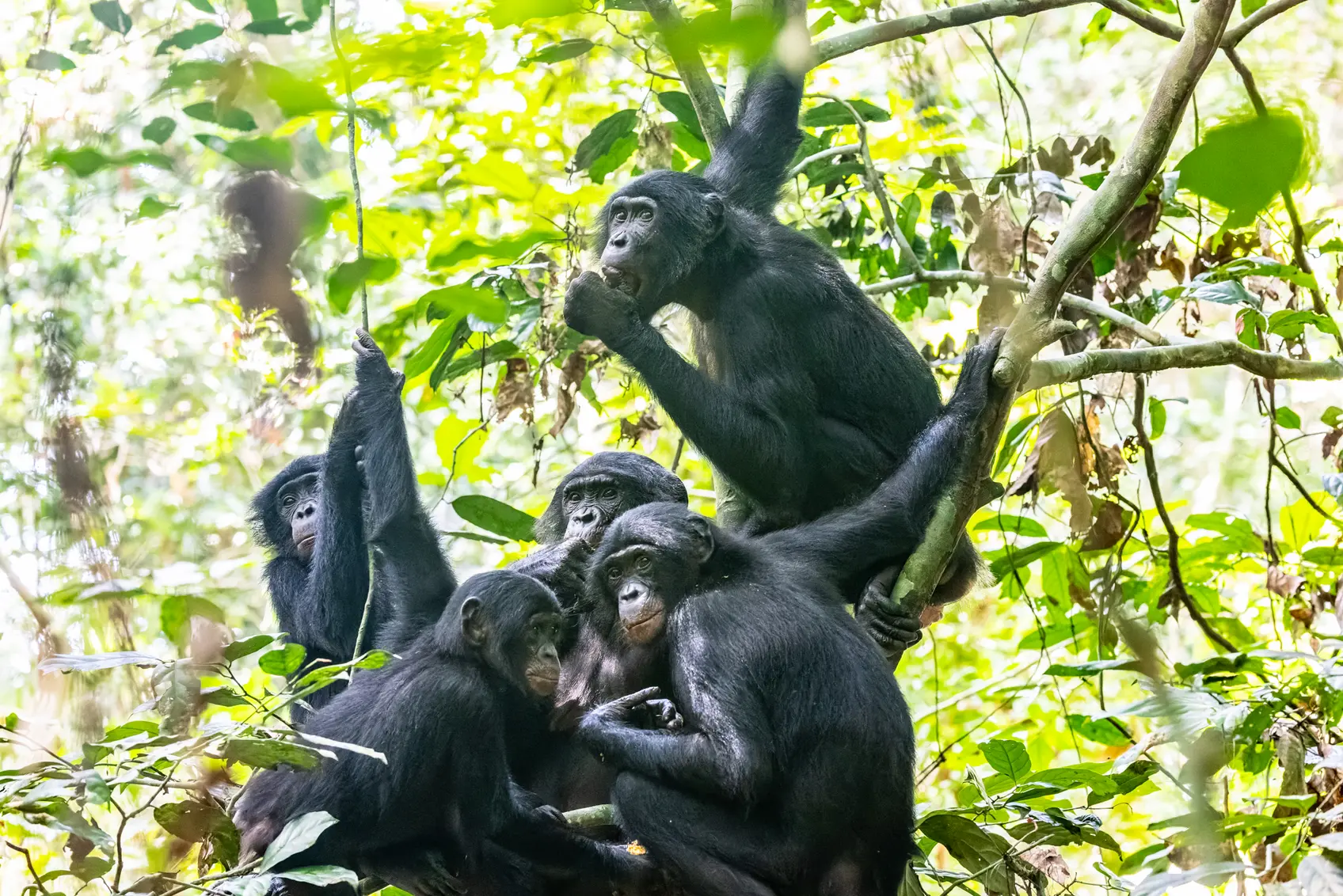
A twenty-year study in Congo's largest protected park confirms that rangers are effective in preserving endangered bonobos. Now, real-time AI surveillance is poised to transform how we protect them.
Scientists now know how many bonobos live in one of the largest pristine tropical forests, a place believed to be the world’s stronghold for the endangered species. The research, conducted over two decades by a team of 48 scientists, estimates that between 8,000 to 18,000 adult bonobos inhabit Salonga National Park in the DRC. Although the population has remained stable since 2000, there are signs of potential decline. The study, led by researchers at the Max Planck Institute of Animal Behavior, also identifies specific factors that have a positive effect on bonobo numbers, offering concrete measures for conserving bonobos across their range.
Salonga National Park in the Democratic Republic of the Congo is Africa’s largest protected forest park, covering an area the size of Switzerland. It is pristine, primary forest renowned for being a sanctuary for the largest population of bonobos, a species of great ape found only in the Congo. In Salonga, bonobos are relatively safe from the deforestation and commercial hunting that threaten their existence elsewhere.
But there’s a problem with Salonga’s title as the bonobo bastion of the world: the exact number residing in Salonga was never known due to the absence of any comprehensive study across the park’s vast range, which comprises 33,000 km² of protected forest and a 9,000 km² corridor of human settlements. "There was an old number floating around of how many bonobos there were in Salonga," says Barbara Fruth who led the IUCN red list assessment of the species in 2016, "but this was an assumption based on surveys covering less than twenty percent of the entire park."
Indeed, the total population of bonobos across Congo is also unknown, due to the difficulty of surveying across the species’ habitat. But Fruth and other scientists recognized that Salonga offered a key to unlock much-needed answers for understanding these understudied great apes. "The unique thing about Salonga is that it is the only place where surveys have been repeated in the same areas," says Fruth, a group leader at the Max Planck Institute of Animal Behavior. "In this vast country, only Salonga offers the opportunity to model trends and assess whether bonobos are declining in Congo."
"Estimating the population of bonobos in Congo’s largest protected park is a significant step in conservation efforts," adds Mattia Bessone, first author on the study. "We highlight the effectiveness of park rangers in preserving this endangered species, showing that Salonga’s success can serve as a model for other conservation projects."
Compiling Twenty Years of Data
Mattia Bessone, a postdoctoral researcher with Fruth, led the effort to combine all surveys conducted in Salonga between 2000 to 2018, amounting to 13 surveys by 48 scientists. Bessone faced challenges due to the varying methods used to count bonobos, ranging from traditional nest counting to modern motion-triggered cameras.
He used statistical techniques to reconcile these differences and provide estimates for bonobo populations across the entire range of Salonga, including areas previously unstudied. This work represents the largest temporal comparison of a bonobo population to date, underscoring its significant geographical scope.
What Bonobos Need to Thrive
The study estimates that 8,000 to 18,000 adult bonobos live in Salonga, a result that "is not that surprising," says Bessone, as it aligns with past extrapolations from smaller surveys. The population number also appears to have remained stable since 2000, but the scientists discovered a concerning downward trend in both density and distribution, though this is not statistically significant. "What this tells us is that bonobos are not in immediate danger, but we need to stay vigilant and to keep investing in conservation efforts if we are to ensure their survival," says Bessone.
The study draws attention to specific factors that could guide where future conservation efforts are focused. Primary forest cover is the main predictor for bonobo occurrence, while proximity to villages negatively impacts their presence. But not all humans keep bonobos away. Bonobos occur more often near park ranger posts, highlighting the protective effect of law enforcement. "We can’t say what the rangers do specifically that leads to this effect," says Bessone. "It could be that rangers are a possible deterrent to poachers. Whatever the reason, it is clear that just the presence of law enforcement has a positive effect on bonobos."
Indigenous People Protect Bonobos
Another bright spot emerged in the park’s south side, where villages from a traditional minority have been living since before Salonga National Park was established in 1970. "In these villages there is a cultural taboo that prevents hunting of bonobo," says Bessone. "It could be this that creates the positive effect they have on bonobo abundance."
Through long-term monitoring in one of the most pristine places in Africa, the study’s implications are significant. "The biggest threats to bonobos are deforestation and commercial hunting, and our findings show that preserving forest and investing in law enforcement has concrete benefits for bonobo conservation," says Fruth. "We hope this motivates national and international conservation authorities to invest more into Salonga and other protected areas to ensure that bonobos remain part of our world far into the future."
From Years of Research to Real-Time Protection
This study took two decades to compile, spanning 13 surveys across 18 years of field work. That timeline is not unusual in conservation science. It is the norm. Researchers spend months, sometimes years, collecting data in the field, only to wait additional months for analysis before results can inform action on the ground. By the time findings are published, the landscape they describe may have already changed.
That gap between observation and action is exactly what we set out to close.
In the summer of 2025, Geologic Dome partnered with WWF and Microsoft’s SPARO initiative, part of their AI for Good Lab, to deploy six of our dome surveillance devices into Salonga National Park. Each dome houses multiple cameras capable of continuous, 360-degree monitoring, connected via Starlink satellite for 24/7 real-time data transmission, even from the most remote corners of the park where no cellular infrastructure exists.
The experience of deploying in Salonga confirmed what we had long believed: the bottleneck in conservation is not a lack of care or commitment. It is a lack of persistent eyes. Rangers cannot be everywhere. Traditional surveys capture snapshots. Camera traps sit dormant between triggers. What was missing was an always-on system that could watch, analyze, and alert in real time.
That is what these domes provide. With onboard AI processing, the devices can identify species, detect human activity, and flag anomalies the moment they occur, not weeks or months later in a research paper. What Bessone and his team painstakingly assembled over 20 years of survey data, estimating bonobo density, mapping distribution, correlating ranger presence with population health, can now be tracked continuously and updated in real time.
The combination of Starlink connectivity and edge AI is a genuine inflection point for conservation. Starlink eliminates the infrastructure barrier that has kept places like Salonga in a data blackout. AI eliminates the processing barrier that has kept researchers buried in months of manual analysis. Together, they compress research cycles that previously took years into something closer to live intelligence.
This does not replace the irreplaceable work of field researchers and rangers. It amplifies it. It means a ranger post can receive an alert within minutes of unusual movement in a sector. It means researchers can monitor bonobo nesting patterns across the entire park simultaneously, rather than extrapolating from a handful of transects. It means the "concerning downward trend" that Bessone’s study carefully flags can be watched in real time, and responded to before it becomes statistically significant in the wrong direction.
Salonga is where we proved the model works. The next step is scaling it, not just across this park, but across every ecosystem where the gap between knowing and acting costs lives.
Because by the time a twenty-year study is published, the world it describes is already different. The question is whether we are watching closely enough to protect what remains.